Osun 2022 & The Mainstreaming of Cash’N’Carry Elections By Tunji Suleiman
Successive administrations of Nigeria’s government by greedy and wicked leaders, have cumulatively pauperized Nigerians, particularly in the 23 years of Nigeria’s Fourth Republic since the transition from military to civilian rule.

Wholesale economic ruination of the oil-rich African nation, and the pervasive and generational nature of the poverty brought upon the people weakened the electorate’s immunity, infected and turned it host to a sub-culture of electoral bribery in the cankerworm of ubiquitous graft that afflicts the nation’s body-politick
The unpardonable crime of politicians who deliberately weaponized hunger and disease, poverty and underdevelopment to keep the people down and under control makes it unrealistic and futile to expect a hungry and poor voter to reject food or money unabashedly brandished at a polling unit in a bizarre trade for votes.
Perplexing as its ascendancy undoubtedly is as a factor over more important issues of the economy, education, employment, healthcare, security, et al; vote buying has become a key feature of candidate selection and election, and determinant for emergence of office holders at all levels of Nigeria’s politics.
More worrisome perhaps is the unsavory reality that many voters have themselves gone rouge in a perverse reaction matching the myopic and selfish character of the political class. They no longer wait to be offered, but actually expect and now demand money upfront to vote and, in their own reckoning, cash out at the polling unit. They thus sell their franchise for crumbs, not minding that such parochial view of the vote, and their chance to contribute to make or mar fates and fortunes and lives and futures of generations of Nigerians unborn, which they mortgage for a pittance, is irretrievably linked to their parlous existence.
This article does not pretend to proffer the ultimate solution to the foreboding dimension and trend in the nation’s political evolution. The writer only hopes, like other well-meaning Nigerians, that if we get 2023 right and birth real change; a visionary, sincere and progressive leadership can – through sound economic management as well as aggressive human and infrastructural development – bring, within the shortest possible time, a large chunk of our population (now estimated at 93 million poor) out of the poverty and hopelessness into which they are mired by the greed of a leadership class that is arguably the world’s worst specie of ‘homo corruptus’ in any political ecosystem.
In the interim, it seems pragmatic to reconcile with the reality that most voters will collect whatever seeming freebies politicians bring. One may only hope that they nevertheless vote for conscience.
This stance is reinforced by what played out on,Saturday, 16 July 2022 in the Osun State gubernatorial elections, where voters reportedly collected NGN 10k and 5k each respectively from both ruling and opposition candidates, yet rejected the incumbent governor and voted for the challenger that is said to have paid less.
Earlier in May through June 2022, parties selected flag bearers for 2023 state and federal legislators, governors and president in massive vote buying circuses. Copious amounts in foreign currency bought and paid for votes of an elite political merchant class whose wares crystallized into tickets. The brazen display and sheer depravity of bribery in the presidential primaries, particularly of the ruling and main opposition parties, were appropriately dubbed ‘dollar bazaars’.
In the classic case of ‘ole gbe ole gbaa’, robber snatching what thief stole, elite party men or delegates were said to have left convention grounds smiling home with up to USD50,000 or more each, extracted from aspirants from among whom the highest bidders emerged candidates as low bidders licked wounds of defeat and lost funds or loot.
Despite spirited advocacy and the principled stands of pockets of voters to reject money for votes, the Ekiti gubernatorial polls of June 18, shortly after the presidential primaries were no less marked by votes buying. When hunger enters the stomach, there’s no space for anything else, not least of all, morality, in Nigeria’s dirty politics. The Ekiti polls, like others in recent times, boiled down to votes bought and sold.
Yet, vote buying, all considered, is an evil wind that will blow Nigeria and Nigerians no good.
Simply put, vote buying, and by implication selling, which requires huge outlays of funds of virtually inestimable value relative to the would-be honest income from offices sought, is the ultimate license on commercialization, literally, of public office as business for profit.
It will further pauperize the electorate, and close the political space to ambitious and qualified Nigerians with no access to ill-gotten wealth – euphemistically christened ‘political warchest’ – to buy votes.
The painful fallout is that credible aspirants with sound and workable manifestos, demonstrable track records of cognate experience and accomplishments in private life relevant to performance in public office, and who are genuinely motivated to serve selflessly, but without ‘financial capacity’ are out-priced and invariably excluded and/or denied opportunities in elective political offices and to provide good governance in public interest. This in turn reinforces corruption and fuels ‘beat them or join them’ resignation to its primacy and inevitability. Proceeds of graft thus become key to entry and success in politics and increase the ranks of past and present looters and looters-in-waiting that we may together call ‘lootocrats’ or the ‘looterati’ for want of better words. Help is thus delayed and hopes of rescuing the nation from the doldrums of backwardness further imperiled.
So as admonitions against the mainstreaming of cash and carry polls increasingly become counter-culture to voters, it seems more pragmatic to concede that electors collect if they must, but still stiff bad leaders by voting them out regardless.
Now, this is by no means endorsement for vote buying or its role in the emergence of yesterday’s winner of the governorship election in the state of the Living Spring. But it will be remiss to not note the futile idealism of expecting hungry folks to pass on food that, though not nourishing, is immediately available.
It is in this premise that one may perhaps suggest that in addition to admonitions against votes selling, a subtext – “Collect the money for it is loot or (re)-investment to loot more, but vote right” – be added to the reorientation refrain going into 2023.
February 2023 beckons and so we can not afford to repeat mistakes of the past and/or perpetuate lamentations of the present by recycling ‘jegudujera’ leaders who loot the people’s commonwealth only to stuff in Ghana-must-go bags and septic tank vaults, or spirit away in bullion vans or lavish in foreign jurisdictions.
Nigerians of voting age should take advantage of what remains of the extension window to 31 July 2022 to participate in the continuous voter registration excercise and to obtain and/or revalidate PVCs, which they have done commendably so far, to be able to vote and vote right next year. Only through informed political participation, can we hope to end the reign of locusts and usher in a new lease of life for our beleaguered nation.
The electorate is best advised to disregard cynical rhetorics of those who claim votes don’t count and other bunkum; for they are contents of political idiots, neophytes or partisan operatives who will rather foster voter apathy to continue to manipulate the process. If votes don’t count, politicians won’t buy them or otherwise rig elections.
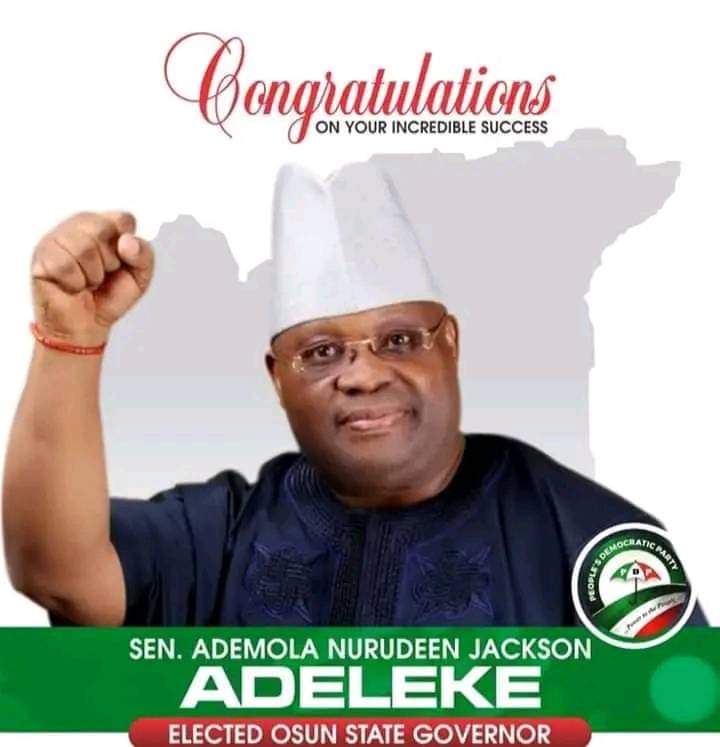
Congratulations to Senator Nurudeen Ademola Jackson Adeleke, Governor-elect of Osun State.
Long live the Federal Republic of Nigeria.
Suleiman is an IT consultant and Security Monitor’s Column Editor
About Author