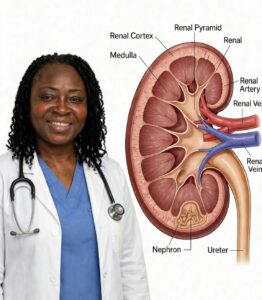
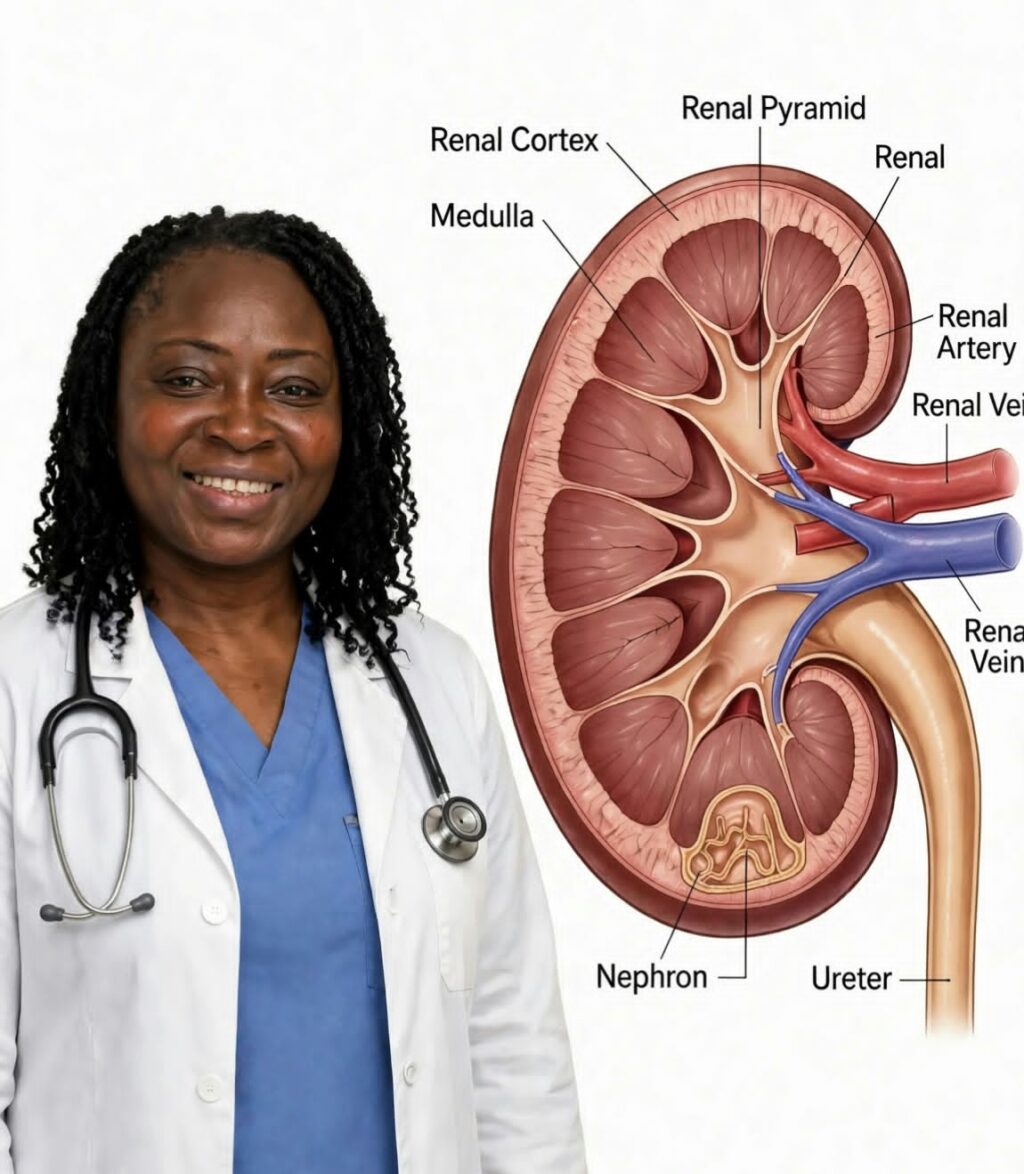
Nigeria is sitting on a time bomb, and it is not insecurity, not economy — it is the kidney.
The management of Wellington Neurology and Neurosurgery Hospital (Wellington Clinics), Abuja, has raised a red flag that should jolt every Nigerian and every level of government: an estimated 9,000 kidney failure cases are recorded monthly in Nigeria.
9,000 Nigerians every month. That is 300 Nigerians every day. 12 Nigerians every hour. Whose kidneys have failed.
This is no longer a health challenge; it is a national emergency.
Findings show that what is driving this epidemic is a dangerous cocktail that Nigerians have normalized — fake drugs, unregulated herbal concoctions, excessive self-medication, abuse of painkillers, bleaching creams, and poor lifestyle choices.
In markets across Lagos, Onitsha, Kano and Abuja, herbal mixtures are sold in bottles without NAFDAC number, without dosage, without expiry date. A man with malaria takes three different antibiotics, adds agbo, adds painkillers. A woman who wants to be fair takes bleaching creams laced with mercury and steroids that destroy the kidney. A young man who wants to be strong in bed takes untested aphrodisiacs. All these end up in the kidney — the silent filter that suffers in silence until it collapses.
The statistics from Federal Hospitals paint a grim picture of a country in distress.
At Lagos University Teaching Hospital (LUTH) and Federal Medical Centre, nephrologists report that dialysis units are overstretched, with over 40 new cases of chronic kidney disease weekly. Many patients are between 25 and 45 years — the productive age.
In University College Hospital (UCH), Ibadan the premier hospital in the Southwest, the kidney clinic is flooded. Doctors say 60% of kidney cases they see are already at end-stage, requiring dialysis that costs N40,000 to N60,000 per session, three times a week — a cost no average Nigerian can afford. Many simply go home to die.
In Ahmadu Bello University Teaching Hospital (ABUTH), Zaria, serving the entire Northwest, the story is worse. Rising cases of hypertension and diabetes, poorly managed due to fake anti-hypertensive drugs in circulation, are pushing thousands into kidney failure.
In University of Port Harcourt Teaching Hospital (UPTH) and Federal Medical Centre, Yenagoa, oil pollution, consumption of contaminated water and excessive use of local gin laced with chemicals have added to the crisis in the Niger Delta.
And here in Abuja — at National Hospital Abuja, Federal Medical Centre Jabi, and private specialist centres like Wellington Clinics — the trend is frightening.
This is why the alarm raised by Wellington Hospital must not be treated as another press statement.
What must government do as a matter of urgency?
First, declare kidney failure a public health emergency. The Federal Ministry of Health must set up a National Kidney Health Taskforce to map the true burden of the disease.
Second, war against fake drugs must be total. NAFDAC must return to the streets, not just the offices. The open drug markets in Idumota, Onitsha Bridge Head, Sabon Gari Kano must be sanitized.
Third, regulate herbal concoctions. Not all herbs are bad, but no one should sell any liquid to Nigerians without standardization, dosage and scientific validation.
Fourth, invest in specialist healthcare.* Nigeria has less than 300 practicing nephrologists for over 220 million people. Most dialysis machines are concentrated in Lagos and Abuja. Federal Medical Centres must be equipped with functional dialysis centres and kidney transplant facilities to reduce medical tourism.
Fifth, National Health Insurance must cover kidney disease. Today, dialysis and transplant are largely out-of-pocket. Government must include comprehensive kidney care under NHIS.
But while government acts, Nigerians must also save themselves.
The kidney has simple demands: water and discipline.
As a nephrologist, I advise that every adult should drink adequate water daily — 2.5 to 3 litres for most adults — to help the kidney flush toxins. Not soft drinks. Not alcohol. Water.
Exercise at least 30 minutes daily. Walk, jog, cycle. Exercise controls blood pressure and diabetes — the two biggest causes of kidney failure.
Stop abuse of painkillers. Paracetamol is not candy. Ibuprofen, diclofenac taken daily without doctor’s prescription destroy the kidney slowly.
Check your blood pressure and blood sugar regularly.
Avoid bleaching creams and untested aphrodisiacs.
Do annual kidney function test. A simple creatinine and urinalysis test that costs less than N5,000 can detect kidney problem early.
Nigeria cannot afford to lose 9,000 citizens every month to a preventable disease.
If we act now, we can save the kidney and save Nigeria. If we ignore it, the epidemic will consume the nation.
The time to act is now.
Susan Ajimuda is a Nephrology Specialist with the Federal Ministry of Health. She is a member of both the Nephrology Society of Nigeria and the International Society of Nephrology
About Author