SCP 2026: HEDA TRAINS OVER 500 FARMERS, STAKEHOLDERS IN LOCAL LANGUAGES ACROSS 17 STATES ON SEASONAL CLIMATE FORECAST
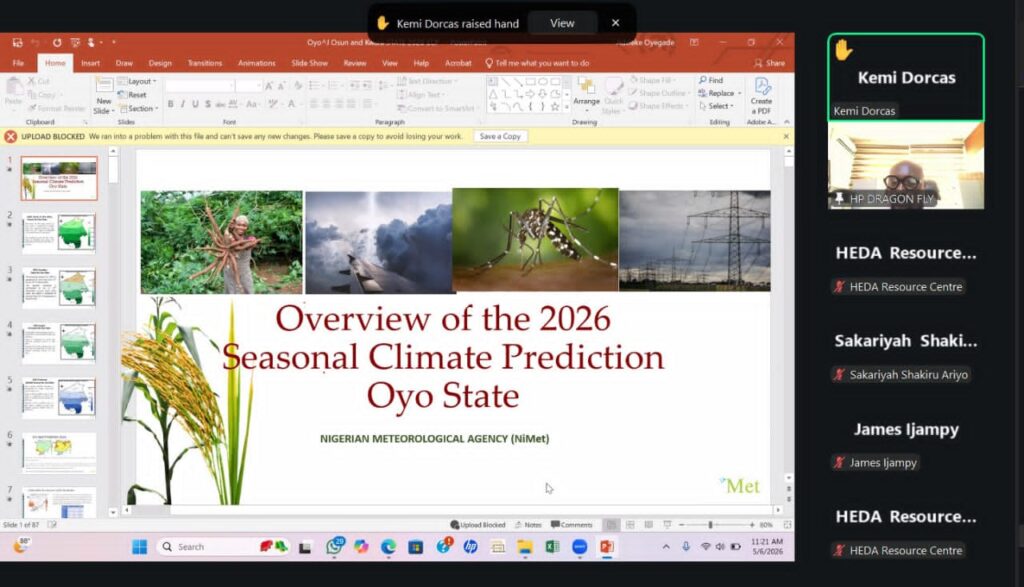
Wuddeama Manga// In its continual efforts to bridge the information gap between smallholder farmers and climate science, HEDA Resource Centre has trained and sensitised over 500 farmer leaders, cooperative representatives, extension actors, and agricultural stakeholders on the 2026 Seasonal Climate Prediction (SCP) in local languages across 17 states and all six geopolitical zones of Nigeria.
The just-concluded four-day hybrid training programme jointly organized by HEDA Resource Centre, Nigerian Meteorological Agency (NiMet), Country Women Association of Nigeria (COWAN), Nigerian Association of Women in Agriculture (NAWIA), and Association of Small Scale AgroProducers in Nigeria (ASSAPIN), was designed to improve farmers’ access to climate information and strengthen their ability to understand, analyse, and utilise seasonal climate forecasts for agricultural decision-making. The initiative also aimed at breaking the communication gap between climate forecasts, policy discussions, and practical implementation at community level.
The programme deliberately mobilised participants with strong community reach and influence, including members of farmer cooperatives, extension networks, women farmer groups, and local agricultural associations who are in turn expected to further share lessons from the training within their communities and support wider awareness on climate-smart farming practices during the 2026 farming season.
The programme combined virtual training with physical community participation. While sessions were delivered online, local partners across several states mobilised and gathered participants in central locations where they jointly participated in the training and sensitisation sessions. This approach ensured that farmers without smartphones, stable internet access, or digital literacy were not excluded from the programme.
Speaking on the initiative, HEDA’s Executive Secretary, Mr. Sulaimon Arigbabu, noted that the gap between climate science and the farmer’s field remains one of Nigeria’s most pressing and underappreciated challenges.
“Climate information is only useful when the people most affected can understand and apply it. This training is our commitment to closing that gap, not just in English, but in local languages such as Yoruba, Igbo, Hausa and Pidgin which our farmers speak and understand,” Arigbabu said.
The training recorded seven sessions held over four days, covering states including Adamawa, Bauchi, Niger, Kaduna, Oyo, Osun, Kwara, Lagos, Ogun, Benue, Nasarawa, Imo, Abia, Cross River, Bayelsa, Plateau, and Taraba. Participants included smallholder crop farmers, livestock keepers, fisheries and aquaculture practitioners, extension agents, agricultural researchers, cooperatives, and personnel from State Ministries of Agriculture.
The sessions guided participants through the practical implications of the 2026 SCP for planting calendars and crop variety selection, flood risk awareness and early warning, livestock management under variable rainfall conditions, fisheries and aquaculture planning, soil and water conservation, and post-harvest loss reduction strategies. Lessons also focused on practical actions farmers can take before and during the farming season to improve resilience and food production despite changing climate conditions.
Meanwhile, HEDA has called on institutions across sub-nationals, particularly State Ministries of Agriculture across the 36 states, to build on this momentum by ensuring that the 2026 SCP is further cascaded to local government and community levels before and during the planting season.
The organization maintained that state governments must work more closely with NiMet to localize climate predictions for their specific agricultural zones and leverage state-owned radio and broadcast media to reach farmers who may not be accessible through virtual platforms.
Similarly, the group urged the Federal Government, through its relevant agencies, to invest in expanding community-level climate information systems and extension support. According to HEDA, trained individuals embedded within farming communities can play an important role in translating technical weather and climate advisories into practical guidance that farmers can use throughout the farming season.
About Author