Save Our Kidneys, Save Our Future: A Wake-Up Call To Government And Every Nigerian’ By Susan Ajimuda
Today, as I add one more year to my life, I give thanks to God. But celebration without reflection is incomplete. I am using this birthday to raise an alarm that must not be ignored — the rising rate of kidney problem in Nigeria.
Our health is our true wealth. And right now, our kidneys are under serious threat.
Recently, the management of Wellington Neurology and Neurosurgery Hospital (Wellington Clinics), Abuja, has raised a red flag that should jolt every Nigerian and every level of government: an estimated 9,000 kidney failure cases are recorded monthly in Nigeria hospital cried out that the numbers are rising too fast, and if nothing is done urgently, we will continue to lose our great men and women to a condition we can prevent.
That alarm from Abuja is not just for Abuja. It is for the whole of Nigeria. If one hospital can record thousands of cases in a short period, what is happening in Lagos, Kano, Kaduna, Port Harcourt, Enugu, and in our villages where there is no hospital at all?
We cannot afford to be silent.
The kidney is one of the most important organs in the body. It is our natural filter.
It removes waste from our blood, controls our blood pressure, balances water and salt, produces hormones that help our body, and keeps us alive every day.
When the kidney is damaged, the whole body suffers. And unlike many other problems, kidney failure does not shout — it whispers. By the time many people discover it, it is already late. That is why it is called a silent killer.
1. Food: What We Eat Is Killing Us Slowly
In Nigeria today, our eating habits have changed dangerously.
We consume too much salt, too much seasoning cubes, too much processed and packaged food, too much fried food, sugary drinks, and alcohol. At the same time, we eat less fruits, vegetables, and natural foods.
With this harsh weather and heat, many people do not drink enough clean water every day, yet they load their bodies with salt and sugar. This puts heavy pressure on the kidney.
People must be taught what to eat, what not to eat, and how much clean water to drink daily, especially in this hot season. Our food should be our medicine, not our poison.
2. Drugs: The Danger of Self-Medication
This is one of the biggest causes.
Many Nigerians take painkillers for every small headache, antibiotics without prescription, and all kinds of drugs without asking a doctor. This abuse destroys the kidney slowly.
We must also talk about herbal mixtures. Many herbal mixtures sold in motor parks, markets, and on the streets have no measurement, no label, and no safety tests
We do not know what is inside them, yet we drink them every day.
Some of these mixtures contain substances that damage the kidney permanently. Government must regulate them. Traditional medicine is good, but it must be safe, tested, and properly dosed. We cannot drink what we do not know.
4. Lack of Check-Up and Ignorance
How many Nigerians have ever done a kidney function test? How many check their blood pressure and blood sugar regularly?
Many people only go to hospital when they are already very sick. Early detection can save life. Regular check-up is not a waste of money — it is an investment in life.
5. WHAT WE MUST DO DAILY TO KEEP OUR KIDNEYS ACTIVE AND WORKING
Prevention is cheaper than cure. These are simple daily habits, backed by international health standards:
a) Drink Enough Clean Water Daily:
Water is the kidney’s best friend. It helps the kidney flush out waste easily.
– International standard: An adult should drink about 2 to 3 litres of clean water daily — that is about 8 to 10 glasses
– In hot weather like Nigeria, especially in the North, drink more — up to 3 to 3.5 litres if you sweat a lot or work outside.
– Do not wait until you are very thirsty. Sip water throughout the day.
– Reduce sugary drinks, energy drinks, and alcohol — they do not replace water, they stress the kidney.
b) Exercise Regularly:
Exercise keeps blood pressure, blood sugar, and weight under control — three major protectors of the kidney.
– International standard (WHO): At least 150 minutes of moderate exercise per week— that is 30 minutes, 5 days a week.
– Brisk walking, jogging, cycling, swimming, farming, and dancing all count.
– Avoid sitting all day. Even standing and walking around every 1 hour helps your kidney.
c) Eat For Your Kidney:
– Reduce salt to less than 1 teaspoon (5g) per day — WHO standard.
– Eat more fruits, vegetables, beans, fish, and natural foods.
– Reduce fried food, processed meat, seasoning cubes, and sugary drinks.
– If you have diabetes or high blood pressure, control them strictly — they are the two biggest causes of kidney failure worldwide.
d) Do Not Abuse Drugs:
– Do not take painkillers every day without a doctor’s advice.
– Do not take antibiotics without prescription.
– Always tell your doctor about any drug or herbal mixture you are taking.
e) Sleep Well and Manage Stress:
– Sleep 7 to 8 hours daily. Poor sleep raises blood pressure and harms the kidney.
– Avoid smoking completely. Smoking damages kidney blood vessels.
f) Go For Regular Check-Up — The International Standard:
Every adult, especially from age 35 and above, should do this at least once a year:
– Blood Pressure Check
– Blood Sugar Test
– Kidney Function Test (Creatinine / eGFR)
– Urine Test
Early detection can save your kidney. Late detection can cost your life.
What Government Must
Do Urgently
This is a call to action to Government at all levels — Federal, State, and Local Government.
a) Set Up A Mechanism For Awareness:
Government must set up a deliberate, continuous awareness mechanism — not just one-day campaign. Awareness on radio, TV, social media, schools, churches, mosques, markets, and communities.
b) Use Data From Hospitals: The government should collect data from various hospitals across Nigeria, study the pattern, and plan precautions on how to reduce kidney problems. You cannot solve what you do not measure.
c) Federal, State and Local Must Work Together: The Federal Ministry of Health, the State Ministries of Health, and the Local Government Primary Health Centres must all work together. The information must reach the grassroots — the villages, the towns, the ordinary people.
d) Make Screening Affordable: Kidney screening, blood pressure and blood sugar checks must be made affordable and accessible to every Nigerian, in line with WHO Universal Health Coverage.
e) Regulate Drugs and Herbal Products: Fake drugs and untested herbal mixtures must be regulated. NAFDAC and other agencies must be empowered to act.
f) Adopt International Best Practice: Nigeria must align with WHO and International Society of Nephrology guidelines — early screening, prevention, clean water access, and affordable dialysis and transplant care for those already affected.
We cannot continue to lose our great men and women — our fathers, mothers, youths, leaders, and children — to a problem we can avoid.
Our kidney is life. If we lose it, we lose almost everything.
As I celebrate adding one more year today, my message is simple: Long life is not by prayer alone. It is by prayer plus wisdom — wisdom in what we eat, what we drink, the drugs we take, and the herbal mixtures we consume.
Drink enough water. Exercise. Eat well. Check yourself regularly.
Let us take care of our kidneys. Let us educate our families. Let us demand better health for our people
May God protect our health, protect our kidneys, and grant us long life in good health. Amen.
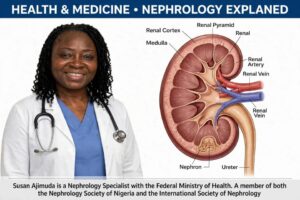
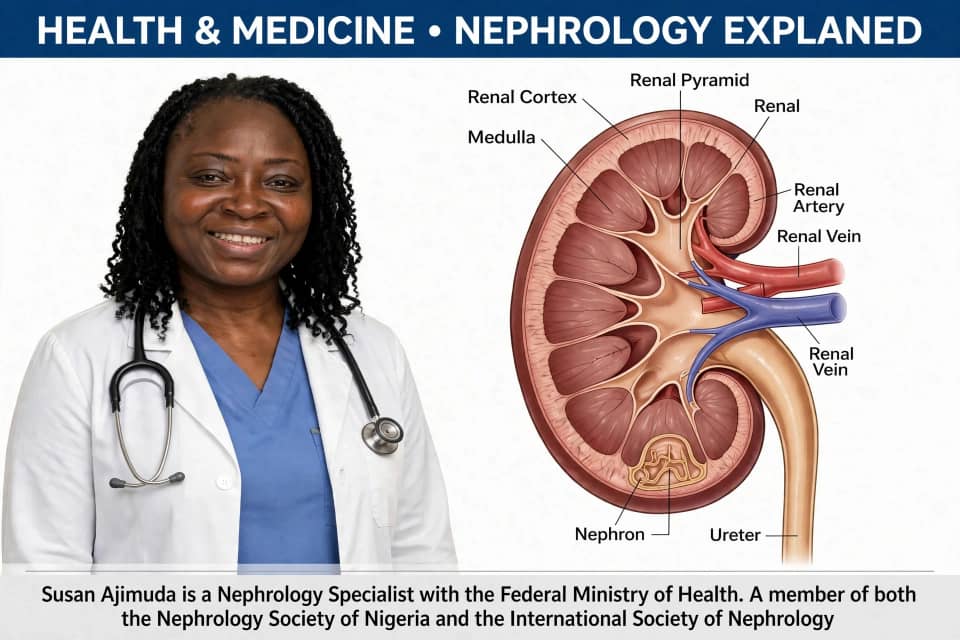
Susan Ajimuda is a Nephrology Specialist with the Federal Ministry of Health. She is a member of both the Nephrology Society of Nigeria and the International Society of Nephrology
About Author