FORTRESS OF SCIENCE: HOW TETFUND’S ECHONO JUST ARMED UNIJOS WITH HIGH-TECH TO WIPE OUT INFECTIOUS DISEASES
By Adagher Tersoo
In the sprawling, rocky terrain of Jos, where the air is cool but the burden of disease has often run hot, a new fortress has risen.
It is not made of stone and mortar alone, but of gene sequencers, mass spectrometers, and the kind of computational firepower that can unmask a virus before it knows it has been spotted.
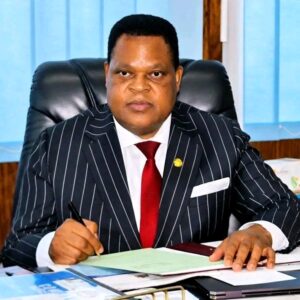
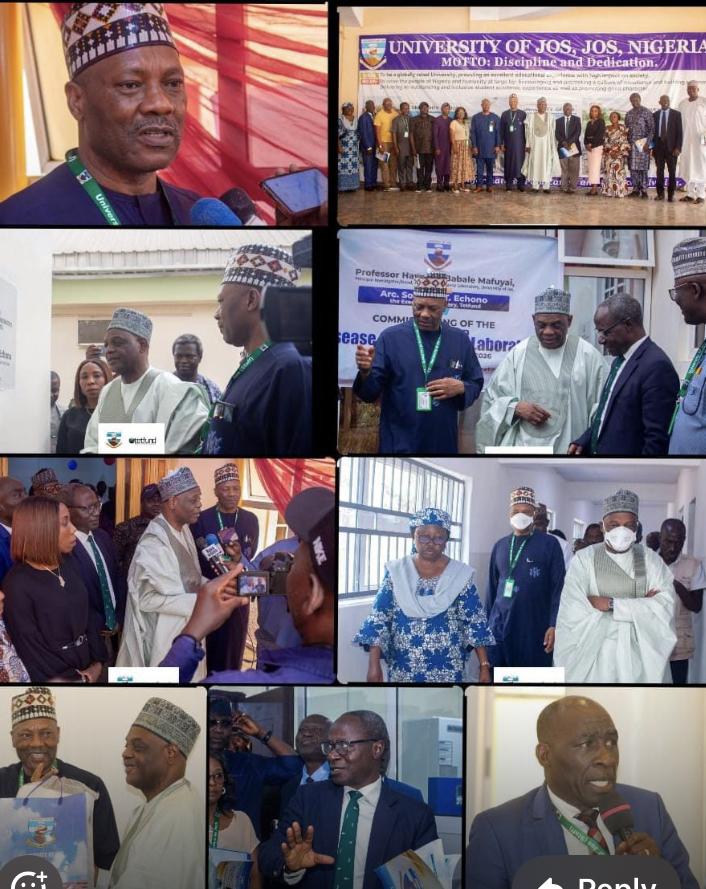
The Executive Secretary of the Tertiary Education Trust Fund (TETFund), Arc. Sonny Echono, formally commissioned two gleaming, world-class facilities at the University of Jos (UNIJOS)—the Infectious Diseases Surveillance Centre and the Multi-Omics and Global Health International Laboratory (MOGHIL).
In a single ceremony, what was once a aspiration became Nigeria’s newest frontline in the war against pandemics.
Funded under TETFund’s 2024 Special Intervention, the twin complexes represent a decisive strategic pivot by the Federal Government, instead of always flying out samples or begging for foreign diagnostics, Nigeria is building its own future, byte by byte, molecule by molecule.
As Arc. Echono cut the ribbon, he was characteristically deliberate. He did not speak in the usual bureaucratic platitudes.
Instead, he turned to the university’s Vice-Chancellor, Professor Tanko Ishaya, and offered a rare, public salute.
What I see here, Echono declared, his voice carrying across the excited cluster of dons and researchers, is a clear demonstration of visionary and purposeful leadership.
He explained that TETFund’s philosophy has evolved. Gone are the days of simply building lecture halls. The new doctrine is about creating ecosystems of excellence.
The Fund is convinced that providing a conducive atmosphere for academic activity remains one of the most compelling strategies for accelerating global competitiveness, he said.
And competitiveness, in the post-COVID era, means one thing, the ability to spot, sequence, and stop infectious diseases before they become national emergencies.
Walking through the labs, one forgets you are in central Nigeria.
The hum of hypercold freezers and the soft glow of high-resolution monitors feel more like Boston or London.
Professor Hayward Muhyai, the Principal Manager of the Disease Surveillance Centre, explained the granular power of the facility.
We can now track the genomic fingerprint of Lassa fever, Yellow Fever, or a new variant of COVID-19 in real-time, he said.
Instead of waiting weeks for results from reference labs in Europe, we get answers in hours.
But it is the second jewel, the Multi-Omics and Global Health International Laboratory (MOGHIL), that truly bends the curve of what is possible in Nigerian academia.
Professor Abraham Dogo, its lead manager, broke it down for the visiting officials.
Multi-omics is the holistic study of life—integrating genomics (your DNA), proteomics (your proteins), and bioinformatics (big data).
Imagine a patient comes in with a fever of unknown origin, Prof. Dogo illustrated.
The old method looks for one bug.
The MOGHIL method scans thousands of genetic markers, analyzes the proteins those bugs are making, and predicts drug resistance.
We don’t just see the enemy; we see its weapons and its armor.
The TETFund boss was not done surprising the University of Jos community.
After the technical presentations and the obligatory group photographs, Arc. Echono dropped another bombshell.
Turning to the visibly moved Vice-Chancellor, he revealed that provisions have already been made for 2025 and 2026 to establish Medical Simulation Centres across public universities, with UNIJOS likely on the priority list.
Furthermore, he approved a special intervention for the university’s ailing Veterinary Teaching Hospital and funds for a brand-new students’ hostel.
An appreciative Professor Ishaya struggled to contain his emotion.
The Executive Secretary has not just given us equipment, he said.
He has given us a reason to believe that Nigerian universities can solve Nigerian problems.”
Yet, the tour was not all gleaming chrome and future promises.
It took a somber turn when Arc. Echono walked over to the Veterinary Teaching Hospital.
There, Acting Director Professor Lami Lombin showed off other world-class TETFund-sponsored labs that are thriving.
But then she led the party to the ruins of hospital buildings tragically gutted by fire in 2022.
The charred skeletons of walls stood as stark reminders that even as progress marches, old wounds remain.
Echono inspected the damage with a forensic eye, nodding silently as the university’s engineers explained the reconstruction challenges.
It was a moment of duality, celebrating the new while mourning the lost, yet committing to rebuild both.
The Takeaway
As the sun dipped behind the Jos hills and the official convoy prepared to depart, a young postgraduate student lingered near the entrance of the MOGHIL lab.
She held a tablet, already queuing her research data.
For years, she whispered to this correspondent, we were taught theory because we had no tools.
Now, we have the tools. Now, we can actually fight.
And that, precisely, is the legacy Arc. Sonny Echono is building. Not just laboratories.
Not just surveillance centres.
But a generation of Nigerian scientists who no longer look outward for answers, because they have built the fortress of science at home.
In the war against infectious diseases, the guns have just been reloaded. And they are firing from Jos.
About Author