I Know What Poverty Is’: Dr. Salihu Bakari Girei Tells APC Leadership His Story, His Record, and Why He Must Be Governor
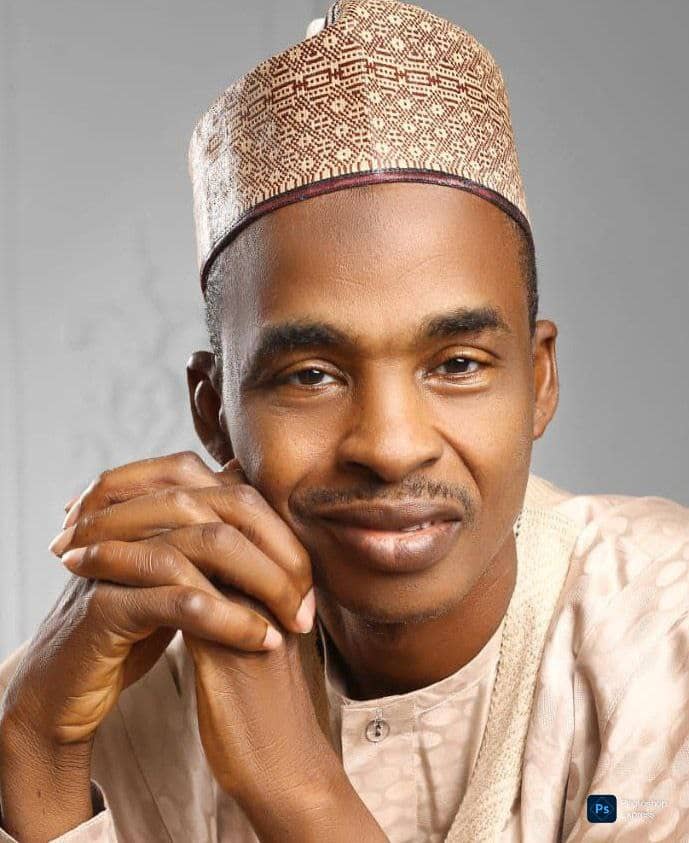
By Tersoo Adagher/ABUJA// There is a difference between a politician who tells a party leadership what he intends to do and one who tells them who he is. Dr. Salihu Bakari Girei, standing before the executive members of the All Progressives Congress at the party’s Adamawa State secretariat on April 24, 2026, did both. But it was the second—the quiet, deliberate unveiling of a painful personal history—that gave the address its particular, almost unsettling texture.
He spoke of growing up so poor that at university, he went forty-eight hours without a single meal. He spoke of owning only two shirts and one pair of trousers. He spoke of his father, a public servant who retired in August 1985 and then waited four years—four years—without receiving a kobo of his pension.
“I know what poverty is,” Girei told the gathered party leaders, his voice steady but carrying a weight that made the room still. “I myself came from a very, very poor background. That is why anywhere I go, I try to ensure that we fight for people. Because I know that people look up to us.”
That kind of testimony is rare in Nigerian political declarations. It is not a manifesto point. There are no bullet points for hunger. Its rarity, however, is precisely its political value. Girei was not merely asking for the party’s ticket. He was arguing that his biography—the scars, the hunger, the humiliations of systemic neglect—is itself a primary qualification for governance. His argument is simple but radical: only someone who has lived inside poverty can be trusted to govern his way out of it.
The Man and the Résumé
Dr. Girei holds four degrees. He mentioned them not to impress but to make a specific, almost forensic argument: he is not coming to government to learn governance from the outside. He has been on the inside—as a teacher, a public administrator, a policymaker, and an executive manager of one of Nigeria’s largest tertiary education funding bodies.
But the centerpiece of his record, and the evidence he returned to repeatedly, is his tenure as Executive Chairman of the Adamawa State Universal Basic Education Board (SUBEB). The numbers he cited were specific, verifiable, and striking:
· 5,000 new classrooms built.
· 17,000 additional teachers enrolled into the system.
· Six months to clear all teacher promotions that had been stagnant for five years.
· Unpaid salary arrears settled.
· Motorcycles provided for school supervisors to monitor even the most remote schools.
· Vehicles supplied to education administrators across every local government area.
The results, he said, spoke for themselves. “Within one year, Adamawa became the third best in education in Nigeria. The second year, we became the second best. History. My legacy is there. Go to any school.”
He also reminded the audience of his work implementing a local apprenticeship scheme that trained thousands of young people and women in vocational skills, as well as his time at TETFund, where he helped operationalize university education infrastructure across the country—a role that gave him a national-level understanding of how higher education systems are funded and sustained.
As commissioner for local government, he described going personally to difficult, insecure areas—climbing mountains alongside security personnel to reach communities that most officials would have avoided. Why? “Because the only way to understand a problem,” he said, “is to stand inside it.”
Specific Commitments, Not Generalities
Girei’s address was not purely biographical. It carried hard commitments, which he framed as logical extensions of his personal experience rather than as generic campaign promises.
On education, he was categorical. He described the cycle of poverty that perpetuates itself across generations—how the children of the poor, denied quality schooling, grow up to raise poor children of their own. “We can only break that cycle when we give these children quality education,” he said. He then invoked South Korea’s teacher salary model as the standard he intends to apply: teachers must become the best-paid and most respected professionals in the state.
On pensions, he was pointed and angry. Describing pensioners receiving four thousand naira per month, he called it “criminal.” He pledged not only to pay all arrears but to review and increase pension values by at least one hundred percent.
On youth, he proposed a grants programme that will likely become a defining test of his candidacy. Any young man or woman with a viable business idea, he said, would receive fifteen million naira in seed funding—with no repayment obligation. “We will provide supplements and grants so that our young people will stop going after politicians,” he said, drawing murmurs of approval. He noted that sixty percent of Adamawa’s population is under thirty-five. A government that does not build systematic opportunity for that majority, he argued, is governing for the wrong people.
On agriculture, he acknowledged the tractor shortage that forces farmers to lobby—and even bribe—equipment operators for access to mechanized ploughing. He pledged to address it at scale. On rural development, he committed to connecting roads, securing communities, restoring water supply, and building infrastructure durable enough to slow the rural-urban migration that is swelling Yola and Mubi while emptying the villages.
The Consensus Question: A Red Line
Dr. Girei addressed the primary process directly and with the specificity that has become a dividing line in Adamawa’s APC governorship race.
He expressed encouragement at assurances from both the Vice President and Governor Fintiri that all aspirants would be given a fair opportunity to contest. He even called on aspirants who had left the party in protest over the primary process to return, arguing that walking away on the basis of assumptions rather than demonstrated facts was a position the stakes did not justify.
But on the question of consensus, he drew a line that his competitors will recognize immediately.
“If consensus means the party sat down, analyzed all candidates, and concluded that another person is more suitable, that is consensus,” he said carefully. “But if you have already made up your mind about one person and you call that consensus, I will never accept it.” He added, for emphasis: “There is a distinction between consensus and selection.”
It was a warning, polite but unmistakable, against any backroom arrangement that pre-determines the outcome.
An Unspoken Evaluation of the Field
Then came what was, in some ways, the most direct evaluation of the governorship field that any declared aspirant has yet put on record. Without naming a single person, Girei drew the contours of who should not be governor:
“You cannot be governor and start looking for people to trust. You cannot be governor and not understand even the names of the wards of the state you want to govern. You cannot be governor and have never visited some of the remotest areas of the state.”
The implication was clear. He was not speaking hypothetically.
He then offered the party five criteria for selecting its candidate: capacity, capability, understanding of Adamawa’s diverse ethnic and religious fabric, a team-player disposition, and demonstrated knowledge of the problems and the people.
He argued that he meets all five from direct experience—not from study or campaign preparation. He cited his cross-LGA roots: born in one local government, raised partly in Song, with foster siblings and shared upbringing across Michika, Madagali, and other communities. That background, he said, gives him a cultural familiarity with Adamawa’s more than fifty ethnic groups that is impossible to acquire through political calculation.
“You cannot bring your card when you are passing through,” he said. “Someone who has been known across the state, from grassroots to national level, is in a fundamentally different position.”
The Closing Argument
Dr. Girei closed with a commitment that framed his entire candidacy around legacy rather than ambition.
“I want to win,” he said. “But more than winning, I want to leave a legacy. I am worried when people become governors and never knew the meaning of governance until they left. I will not be that person.”
The party leadership heard him. The room did not erupt in the performative cheers that often accompany political events. Instead, there was a quieter response—the kind that follows a testimony that cannot be easily dismissed.
The primary will now determine whether they believed him. But Dr. Salihu Bakari Girei has already done something unusual: he has made his poverty, his hunger, and his father’s unpaid pension not a story of victimhood but a set of credentials. And in a state where the cycle of poverty has become a hereditary condition, that argument may prove more powerful than any manifesto.
Adagher Tersoo.
A Public Affairs Analysts Writes from Abuja.
About Author