SINATU ADEOYE’S JUDGMENT LAND: POLICE INVITES OSUN LAWYER, JUDGMENT CREDITORS OVER FRIVOLOUS PETITION BY CONTEMNORS
By Olayiwola Ibrahim // The lingering controversy surrounding the judgment land of Madam Sinatu Adeoye has taken another turn following an invitation extended by the police to Lawyer Lekan Alabi and his clients who were the judgment creditors over a petition allegedly written by some of the contemnors before the Osun State High Court,Ile-Ife Judicial Division in Suit No: HOS/M.206/2024- Between Misitura Busari (Judgement Creditor) vs Hephzibah Holding Ltd.
The individuals identified in the ongoing contempt proceedings include Mr. Kabiru Ajisope, popularly known as Kabtok, Mr. Akeem Bakare, Taiwo Ajibade, Muili Folorunso, Teslim Oladimeji, Rasaq Oladimeji and Hazmat Adeyanju. of these individuals, Akeem Bakare and Taiwo Ajibade were identified as the petitioners against Lawyer Lekan Alabi and the judgment creditors.
They wrote the said frivolous petition against Lawyer and his clients while the Contemnors were under investigation of the Force Headquarters, Abuja over the alleged plan to assasinate the Lawyer Alabi and his clients who are the judgement creditors.
According to the available account, Akeem Bakare and Taiwo Ajibade were at the Force Intelligence Department (FID), Special Tactical Squad (STS) office in Abuja on 14 September,2026, with interviews reportedly conducted on 15 September, in connection with the same land dispute over threat to the life of Lawyer and his clients.
The allegations raised by Lawyer Lekan Alabi against Kabiru Ajisope(Kabtok) and others were still under investigation by the Inspector General of Police.
During the questioning by the Police in Force Headquarters,Abuja, Akeem Bakare and Taiwo Ajibade reportedly stated that the relevant documents were in the hand of Kabiru Ajisope(Kabtok) and that he should appear to produce it.
However, Kabtok allegedly did not appear in Abuja to present the document or respond to the issues raised till the time of filing this report.
Questions have also emerged over a petition reportedly submitted to the IGP office on 14th of September,2026 while Bakare and Ajibade were in Abuja in connection with the same matter.
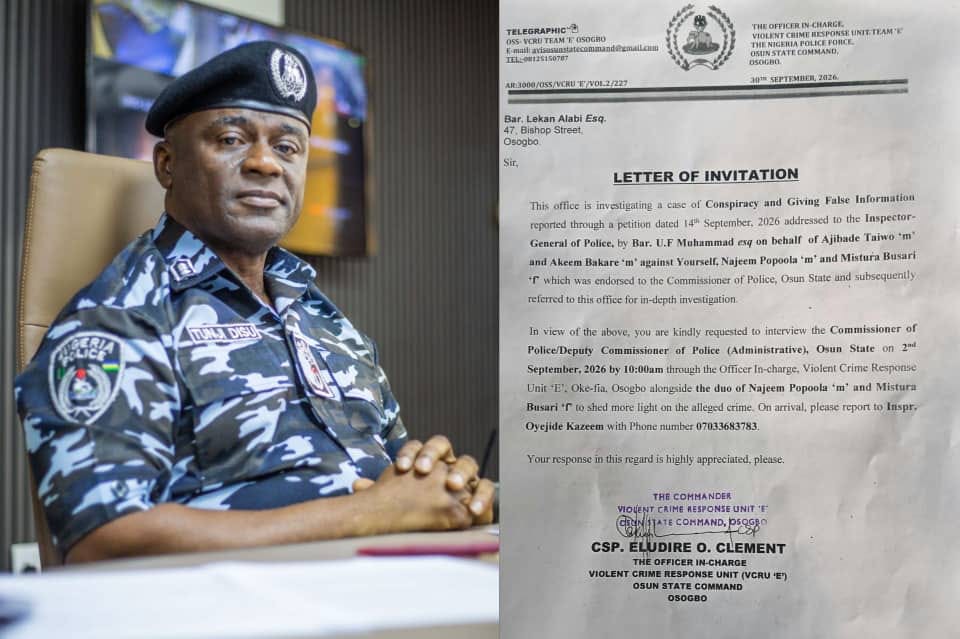
Lawyer Alabi was subsequently invited by the Osun State Police Command, with an appearance scheduled for 2nd of September,2026 which has clearly demonstrated the level of desperation on the part of certain Police Officers in the State Command giving backing to the alleged Contemnors.
The sequence of events has prompted concerns about why a separate petition was pursued at the Osun state command while an investigation into related allegations remained ongoing at the Force Headquarters,Abuja.
It was very cleared to all and sundry that
the State Command of the States of the Federation are working under the operation of Inspector General of Police within the Nigeria Police Force, but they have different levels of command respectively.
The IGP is the overall head of the Force, while the state Commissioner of Police commands the police within the state, subject to the Force’s command structure and applicable law.
Meanwhile, a petition to a state command is not automatically unlawful simply because a related matter is under investigation at the federal level.
However, the existence of parallel process makes proper coordination, transparency and consistency particularly important.
The central question is therefore not whether one office can simply cancel the other, but whether the relevant police authorities are coordinating their investigations and ensuring that no party receives preferential treatment.
More over,concern has been raised that, rather than waiting for the FID/STS investigation to reach its conclusion, Kabiru Ajisope(Kabtok) and persons associated with him allegedly pursued a separate petition before the Osun State Police Command.
Kabtok is also alleged to have previously claimed influence over the State Commissioner of Police but the claim has not been independently established.
If the investigation in Abuja remains active, the authorities should clarify the status of the different petitions and ensure that the state process does not undermine or duplicate the federal investigation unfairly.
Equally, every party must be allowed to respond with relevant information and documents.
The judgment land dispute should not be determined by competing petitions, personal influence or pressure on security agencies. Its resolution must remain grounded in court records, admissible evidence and lawful procedures.
The public deserves clarity, the parties deserve impartial treatment, and the ongoing investigation should be allowed to proceed without intimidation or interference.
About Author