HEDA, PPLAAF SEEK STRONGER LAWS, WHISTLEBLOWER PROTECTION TO TACKLE CORRUPTION, ILLICIT FINANCIAL FLOWS AS STAKEHOLDERS MEET IN ABUJA TO STRENGTHEN ASSET TRACING, RECOVERY FRAMEWORKS
By Olayiwola Ibrahim // The Human and Environmental Development Agenda (HEDA Resource Centre), in partnership with the Platform to Protect Whistleblowers in Africa (PPLAAF), has called for urgent reforms to strengthen Nigeria’s anti-corruption capacity and asset tracing frameworks.
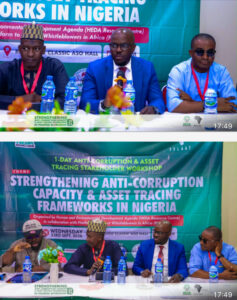
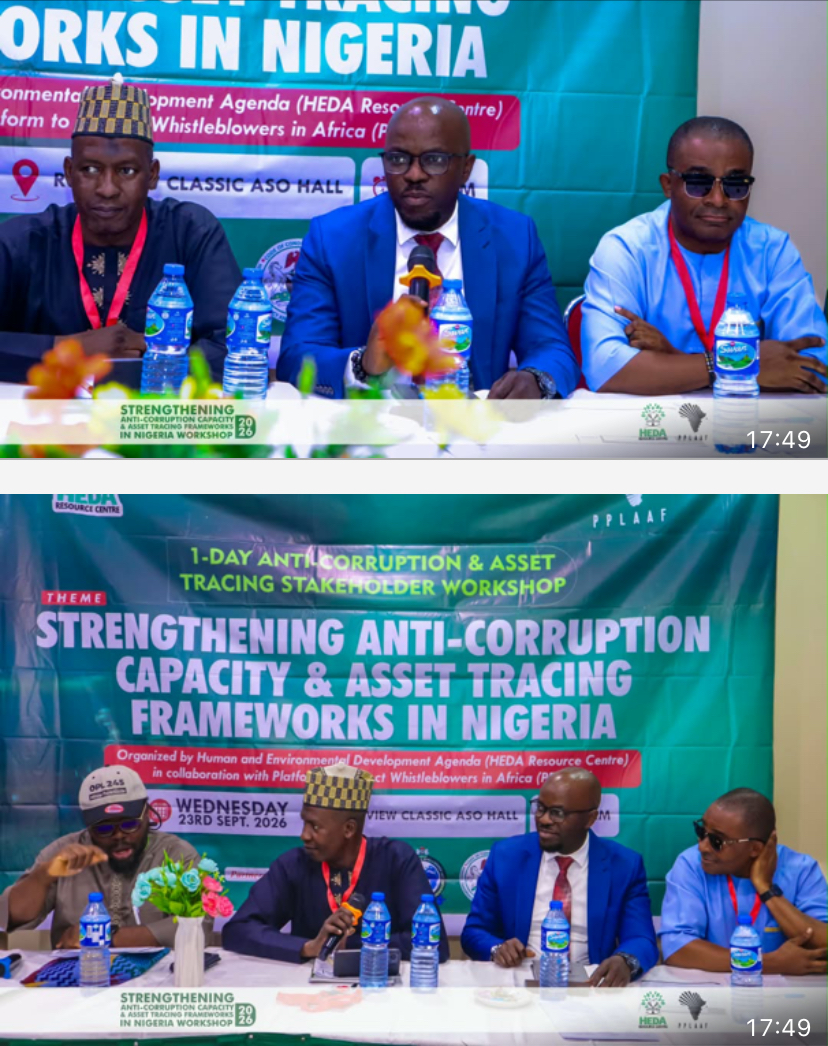
The call was contained in a communiqué issued at the end of a one-day stakeholder workshop held on Wednesday, 23rd September 2026, at Rockview Classic, Abuja.
The hybrid event had 127 stakeholders – 55 physical and 72 online participants – drawn from Anti-Corruption Agencies (ACAs), Law Enforcement Agencies (LEAs), Civil Society Organisations (CSOs) and the media.
Participating organisations included the EFCC, ICPC, Code of Conduct Bureau (CCB), AFRICMIL, CISLAC, Connected Development (CODE), BudgIT, ANEEJ, SERAP, Centre for Transparency Advocacy (CTA), Security Monitor, Aso Radio & TV and Premium Times.
The workshop, themed Strengthening Anti-Corruption Capacity and Asset Tracing Frameworks in Nigeria, observed that financial crimes have evolved from direct diversion of public funds to complex global networks involving offshore trusts, shell companies and high-value real estate in London, Dubai and the United States.
Stakeholders raised concerns over institutional silos and lack of real-time intelligence sharing, underutilization of non-conviction-based forfeiture under the Proceeds of Crime (Recovery and Management) Act (POCA) 2022, absence of statutory whistleblower protection, safety threats against investigative journalists, restricted access to public records and lack of beneficial ownership transparency, citing recent Premium Times reports on offshore assets linked to Politically Exposed Persons.
The stakeholders resolved, among others, to push for:
– Enactment of Whistleblower and Witness Protection Law* to bridge Nigeria’s legislative gap and restore public trust.
– Full operationalization of POCA 2022* and guarantee of financial and operational autonomy for ACAs.
– Digitalization of CCB asset declaration portal to make disclosure of beneficial interests mandatory.
– Domestication of FOI Act 2011 across all 36 states and creation of functional FOI desks.
– Prosecution of professional enablers – lawyers, real estate developers and accountants who facilitate illicit property deals.
– Centralized Beneficial Ownership Registry* integrating CAC, Open Ownership and extractive sector databases.
– Real-time data sharing between ACAs and CAC* to unmask shell companies and proxy directors.
– Leveraging informal global networks like UNODC GlobE Network, Inter-COPS and NACIWA to bypass Mutual Legal Assistance delays.
Protection for journalists and advocates probing corruption, and recognition of electoral integrity as an anti-corruption foundation.
In his keynote, former Director General of GIABA, Prof. Abdullahi Shehu, said Nigeria has a fairly strong legal and institutional framework including the ICPC Act, EFCC Act, Money Laundering Act 2022 and POCA 2022, but implementation remains the challenge.
He called for a shift from arrest and prosecution to systematically tracing, freezing, confiscating and recovering proceeds of corruption, which is the main thrust of POCA 2022.
Prof. Shehu said CSOs and the media have a constitutional role as watchdogs, through budget monitoring, Open-Source Intelligence (OSINT), investigative reporting, strategic litigation and community empowerment, but face political intimidation, limited access to records and funding gaps.
He recommended strengthening independence of anti-corruption agencies, improving financial investigation, beneficial ownership transparency, speedy forfeiture proceedings, transparent asset management register, and protecting whistleblowers.
Stakeholders agreed to deploy the Premium Times research report on the corruption trial that sent ex-Minister Mamman to 75 years imprisonment as benchmark for asset tracing, accelerate launch of CCB’s online portal, formalize encrypted reporting channels for whistleblowers and journalists by EFCC and ICPC, and launch a campaign to compel 20 remaining states to domesticate the FOI Act.
About Author