JOURNALISTS URGED TO PRIORITIZE CULTURAL SENSITIVITY, INFORMED CONSENT IN INDIGENOUS REPORTING, AS FABIAN ANAWO PRESENTS 18 POINT GUIDE AT LAGOS MEDIA PARLEY ON RIGHTS OF ABUJA ORIGINAL INHABITANTS
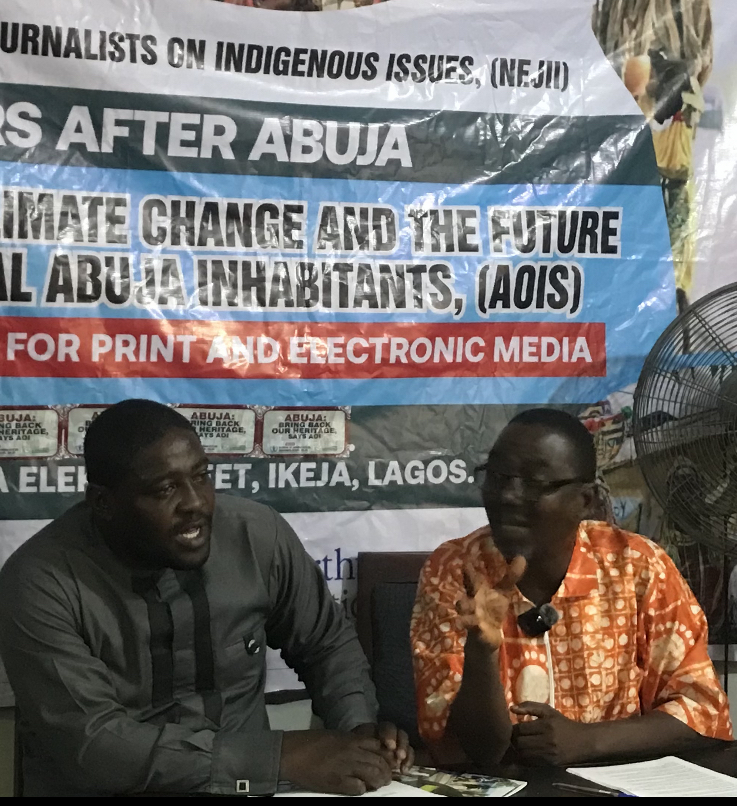
By Olayiwiola Ibrahim // Journalists covering Indigenous communities have been urged to adopt cultural sensitivity, use accurate terminology, and practice ethical storytelling to avoid stereotypes and extractive reporting.
The call was made by Fabian Anawo during a one-day media parley on the Social, Economic and Environmental Rights of Abuja Original Inhabitants held in Lagos on 3rd June 2026.
Anawo presented 18 practical tips to help reporters improve accuracy, fairness, and trust when reporting Indigenous issues.
He stressed that reporting on Indigenous peoples must go beyond trauma and victimization.
Prioritize informed consent, use specific nation names instead of broad labels, and portray communities with multidimensional dignity, Anawo said.
Key reporting tips include:
1. Prioritize Informed Consent: Explain story focus, purpose, and publication platform before interviews.
Respect protocols on traditional knowledge, sacred spaces, and restrictions on photographing deceased persons or shrines.
2. Use Specific Names: Avoid generic terms like Indigenous or Native when the specific nation, tribe, or community can be identified.
3. Learn Local Context: Understand history, governance, culture, and current issues, since past events often shape present concerns.
4. Build Relationships Early: Trust develops outside breaking-news moments. Engage communities at public events and learn their protocols.
5. Prioritize Indigenous Voices: Let Indigenous people speak for themselves rather than relying only on government officials or outside experts.
6. Avoid Stereotypes: Balance stories of poverty or conflict with coverage of innovation, leadership, culture, education, business, and daily life.
7. Understand Sovereignty: Many Indigenous nations have their own governments and laws. Treat these institutions with the same seriousness as other governments.
8. Verify Terminology: Preferences vary. Some groups use Indigenous,First Nations, Aboriginal, or specific nation names. Ask sources directly.
9. Respect Cultural Protocols: Seek permission before publishing images, names, or recordings of ceremonies and sacred sites.
10. Handle Trauma Carefully: Stories on violence, displacement, or historical injustices require extra care to avoid sensationalism and protect survivors.
11. Add Historical Context: Land, resource, health, and legal disputes cannot be understood without historical background.
12. Decolonize Narratives: Resist extractive journalism. Show Indigenous peoples as multidimensional, with leadership, arts, and activism alongside challenges.
13. Listen Actively: Challenge personal biases and let community voices determine the story’s main angle.
14. Compensate Expertise: Consider honoraria when community members provide substantial cultural knowledge beyond a standard interview.
15. Review and Verify: Cross-check names, spellings, translations, and historical details with community leaders. Offer interviewees a chance to review quotes before publication.
16. Avoid Generalization: Thousands of Indigenous communities exist worldwide with distinct cultures. One person’s view does not represent all.
17. Promote Newsroom Diversity: Collaborating with Indigenous journalists and producers improves accuracy and depth.
18. Use Established Guidelines: Refer to resources from the Indigenous Journalists Association, Canadian Association of Journalists, and National Center for American Indian Enterprise Development.
Anawo advised reporters to ask before filing, Would this story help audiences see Indigenous people as contemporary communities with agency and expertise, rather than only as subjects of crisis coverage?
Stakeholders must be considered Anawo noted that Indigenous reporting affects multiple stakeholders.
He categorized them as Primary stakeholders, individuals, families, elders, youth, leaders, and cultural institutions, Government stakeholders, local, state, national governments, and agencies, Civil society, advocacy, human rights, and environmental groups; Economic stakeholders, mining, oil, agriculture, tourism, and infrastructure firms, Knowledge stakeholders: schools, researchers, museums, archives, International stakeholders: UN agencies and global Indigenous networks, and Media stakeholders, journalists and platforms.
He said the most critical stakeholders are the Indigenous community itself, its leaders and elders, government authorities, affected businesses, and advocacy groups.
Building consensus requires respect*
For holistic coverage, Anawo said journalists and media houses must build consensus through respect, inclusion, trust, and meaningful participation.
This includes ensuring Indigenous leadership in discussions, recognizing rights and self-determination, and sustaining engagement beyond project approvals.
He highlighted the connection between Art, Culture, and Spirituality, in Indigenous life. Art expresses history and identity.
Culture holds customs and knowledge systems. Spirituality emphasizes interconnectedness with land and ancestors.
In many societies, a dance is both performance and ceremony, a carving is both art and ancestral teaching,” he explained.
Anawo cautioned against assuming uniformity noting that there is no single Indigenous culture.
Communities in Nigeria, Canada, Australia, New Zealand, and the US have distinct traditions.
Understanding requires learning each community’s own perspective.”
He recommended early engagement, transparent information sharing, inclusive dialogue, respect for protocols, and long-term relationship building.
Durable consensus is more likely when Indigenous peoples are treated as partners whose perspectives shape outcomes, not as groups asked to approve decisions already made, he concluded.
About Author